Monday, April 5, 2010

The Future of the Internet (2)


Welcome to part 2 of the discussion of the topic. I encountered some formatting issues with blogger which messed up screen pretty badly when i tried to manually manipulate the HTMLL code.... i guess blogger is still a long way in pre-empting what i want and does not count as a "semantic web" application... haha.

For instance, when you get out of bed every morning, your personal computer would automatically boot up, load windows and automatically connect to the internet with your frequently visited webpages open and ready to go as soon as you step out of the shower. To achieve such a result in the present day is actually possible, however one will need to manipulate the PC extensively before achieving such a result. As such, semantic web (A.K.A. web 3.0) is still in its infancy.

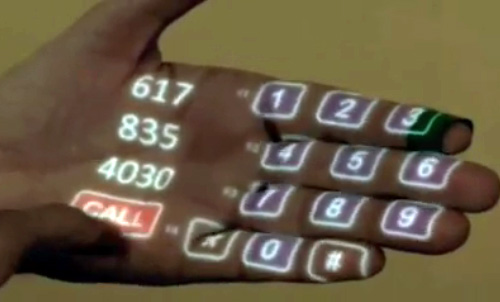
Next in line for the future of the internet is a really cool piece of technology dubbed, "Sixth Sense Technology (SST)"

Words cannot even begin to explain the limitless possibilities of SST, so i shall let the pictures do the talking for now.


Basically what SST is " a mini-projector coupled with a camera and a cellphone—which acts as the computer and your connection to the Cloud, all the information stored on the web" (Diaz 2009)


Basically it makes day to day tasks such as making phone calls and searching the web for information more revolutionary.

For instance, you could hold up your hands in a "square" action and the SST will realise that gesture as a "photo taking" gesture can capture whatever you have in between your hands literally!!!

Soon you will be able to look at something such as a bar code for instance all relevant information will be projected onto your eye retinas in numerous lines of information a la the matrix.


The Future of the Internet

I robot, a film 6 years ago depicting earth and will smith the near future of what earth very well might become.

"it's 2035 A.D., where robots are everyday objects and are programmed to live alongside humans" - Source IMDB

It may be the year 2035 in the film, however this reality might come very soon for us, perhaps in the the next 10 or 20 years.

The internet nowadays is being used for a variety of day to day activities, from personal usage such as purchasing goods and services online, to synchronising multinational corporations whose businesses span the globe.

As the needs of both businesses and personal users of the internet get increasingly complex, internet is slowly starting to evolve.

One such concept is that of "Semantic Web". According to Berners Lee (1992), the "father" of the internet,

"The Semantic Web is an evolving development of the World Wide Web in which the meaning (semantics) of information and services on the web is defined, making it possible for the web to "understand" and satisfy the requests of people and machines to use the web content.[1][2] It derives from World Wide Web Consortium director Sir Tim Berners-Lee's vision of the Web as a universal medium for data, information, and knowledge exchange.[3]"

Monday, February 1, 2010

COM 125 Entry #3

Apologies for the lack of blog postings as of late, i have been very distracted with outside matters till I realised that i have a back log of 2 undone blog entries from the previous 2 weeks. That being said, let's get one of the two entries out of the way: e-Commerce.

E commerce

This topic actually resonates deeply with me as I had tried to start a business revolving around E-commerce after reading about it 2-3 years back.

In a nutshell, the said business of mine revolved around peddling 2nd hand goods through online channels. i made extensive use of social media portals such as facebook and online forums to move my goods (which were in turn obtained from various other people).

The idea was novel at first; random items available for sale at rock bottom prices using the internet as a marketing tool. Well ideas always look good on paper but differs greatly in practise, as i found out later.

Business was brisk at first, with alot of people buying and selling through me. I had to be present physically for the buying of the 2nd hands good and the selling. I enjoyed it at first running back and forth in locations throughout singapore but I started to face a few problems which never went away. I eventually wound down the business in about a few months after starting it up as my school grades were also taking a beating.

So what went wrong with this E-commerce, or psuedo e-commerce?

A helpful analysis of the sitaution would include "Micheal Porter's 5 forces" [of a business].

The first force would be the supplier bargaining; people would contact me with goods they would want to sell and i would post an advertisement on the said online mediums. Now more often than not people tell me, "i want to sell this item at $XXX, you can mark it up to $YYY and you can earn the rest." Most of the time, their quotes for prices are outrages and ridiculous, and i when i tell them this item can't be sold, they would reluctantly lower it, eating into my $YYY - $XXX profit margin. It came to a point when i only earned $1 or $2 off a sale of an item. That represented the "suppliers" bargaining power. They keep throwing me bones to eat instead of meat.

Next comes customer bargaining power, this does not require much thought. When a customer sees something he or she likes, they would make contact with me to view the product. And when they arrive, and they like the product, they would bargain with me over the price. My margin is already so low, and i deal mostly with friends and family, how can i refuse their request for a lower price? Now even my bone is taken away as i have to sell at cost or at a loss.

The threat of new entrants is very great as the online media allows any net savvy individual to set up shop at virtually (no pun intended) no or low cost (which i did). Hence my business model is not very unique as i am considered to have entered the market rather late.

Better substitutes to my service exist in the form of physical brick and mortar locations such as cash converters and sungei road theives market. Online substitutes also include websites such as e-bay. All these services provide a much better service than my small start up and i find it hard to entrench myself against such major players.

In summary, my e commerce business model was not sustainable in the long run.

However, i have learnt some valuable lessons and made useful contacts during the time spent doing this. I eventually wish to come back to this again at some point of time when i have more time and resources to devote to it. For now, my studies have the first priority.

Saturday, January 16, 2010

COM 125 entry #1

Its a new year and a new semester... another COM module with a blog requirement means i get to recycle this address again (Which was in turn recycled from another one of my blogs... haha, save the earth! Recycle bandwith!!)!

So anyway, COM125's title is the "introduction to Internet", and if you must know.... the previous entries were from COM337, Com theory.

Now i consider myself to be quite slow to adopt new technology, i always use my mobile phones for a full 2 years (most of them do not last the 2 years.... they usually break down before that time period due to my rough handling), and i do not feel the need to upgrade to the latest and quickest gaming computers (i used a pentium 4 single processor for a full 5 years before switching to dual core technology only recently last year!) either.

My motto towards technology is, "if it isn't broken.... don't go and fix it!"

The only tech that i am relatively up to date is gaming technology because i am a relatively hardcore gamer myself.

Here's a general list of internet applications that i use everyday in order of most frequently used:

  1. Singapore Bike Forums
  2. Facebook
  3. Online streaming videos (youtube, yousportz)
  4. E mail
  5. Google search
Well that's all for the introductory blog article on the wonderful internet! Next time i shall talk abit more on the applications that i frequently use!

Sunday, December 6, 2009

Comm blog entry #4

Here are some final thoughts about the course.

While it is certainly interesting to know about the various different communication theories that we have learnt, one can't help but feel that some of these theories range from feeling slightly dated (mass communication theories circa '67) to downright bewildering (postmodern theorizing, i had to pause and stop to re-read many portions because it just didn't make much sense the first time round).

Nevertheless there were a few theories that were quite relevant such as the theories about communication communities, we live in many different communities throughout our lives and how we communicate between them certainly seems applicable and relevant.

I must applaud the efforts of professor Robert M Armstrong for doing his best to make his classes engaging and interesting with his many intersting anecdotes while delivering the lecture. I was going to complain about the workload whereby there seemed to be a new project to work on every week when it dawned on me that professor armstrong is going to be one getting the short end of the stick! (6 assignments multiplied by the whole class... maybe 40-60 of us.... and movie reviews to grade....gee I wouldn't want to be him).

It is admirable of him to be such a hard worker.... although i think he could take it easy from time to time... Singapore is already a stressful enough place to live in as it is!

Saturday, December 5, 2009

Much ado about technological determination [Comm blog entry #3]

Having lived through the... birth, no that's not quite right, the infancy of internet rather, i was wondering if the theory of technological determination would apply to the internet, as compared to television which it was originally designed for it in mind. Furthermore, the theory was developed by MacLuhan in about 1967, I wonder if the theory still has any relevance today, let's see...

The medium is the message/massage? The medium here in question would be the computer in which is how one accesses the internet. So the act of using the internet shape how we think and act, well... that would be a resounding "no!"

The internet now is highly personalised, one can choose what to consume and not be as hapless as television viewers who have no control on what programming the television networks choose to screen. Everything online is now effectively "on-demand"; whatever content we choose; whenever we choose to consume it. So obviously one would have to think about what choice he or she might want to consume online first before consumption and not the other way round!

New technologies bring new expectations of immediacy. Oh hell yes! This immediacy was not so pronounced at first, one could get regular updates on news and stories on numerous news websites and blogs by the hour if one wanted to. Now we have certain online tools that let us update (or be updated) to the very second!! What are those tools? I have just two words for you, "facebook" and "twitter", and not to mention "youtube" which allows one to watch anything instantaneously! 'Nuff said!!!

One of the more disturbing trends of this theory is that prolonged use of "hot" media would affect attention through unequal stimulation of the brain lobes. Use of the internet and related modern technologies only stimulate the visual and spatial right side of the brain. As a result, the more analytical and abstract left side of the brain doesn't get a workout, so to speak.

It would not be rare to see young children now absorbed in the use of the internet, videogames, handphones and whatnot. I wonder if they would be able to get enough "exericse" in the left brain to think about things rationally and carefully. They would find it difficult to engage in deep thought about certain issues if that is the case and it seems to be cause for worry.

42 years on, MacLuhan's theory of techonlogical determination still has a relative applicability in this day and age.

Here's a little video to feed you a little food for thought...


Comm blog entry #2 (Behind the scenes - doing research for Org Comm project)

One day, yet another assignment landed on our laps. It required us to find and interview and/or observe an organization for their culture. After some discussion, Lydia came up with the idea of going to her parent's firm for the project, and i was like, "what?? your parents actually OWN a firm?"

And then i realised... hey this is SIM we are talking about, almost everyone here has to have some kind of wealth to begin with, that's why we're here... (i don't consider myself to be obscenely wealthy, just enough to get by, i.e. pay the fees).

Anyway, enough about the wealth have and have nots, it was decided that i was to interview a manager of the firm at their premises. Rode down on a thursday into the outskirts of the Central Business District at North Canal Road (Somewhere in between chinatown and clarke quay stations) to discover that the firm was housed in a nice cozy shophouse along a row of them.

I entered and introduced myself and sat at the reception area waiting for my "target" to arrive. Just my luck, the night before the workers were up late in the office rushing for a submission deadline and hence they were all entitled to report late for work on the following day.

I was sitting there for a whole half hour when i realised i had forgotten to remove my cashcard form my bike... oboy. Hurried to the bike and flipped open the card unit and............ empty........ some greasy fingers had already swiped it ........ curses!! Bloody thieves... only a whole half hour elapsed and its stolen.

I returned to the office with a black face and had to wait another hour before the manager arrived. Needless to say, i wasn't in the best of moods but still managed to force a smile through my scowl.

Due to the fairly long amount of time i spent there, i managed to observe a little into how their office culture operated. Since it was a small firm compared to huge super corporation, the office had a more "village" feel to it; everyone that came in was cheery (partly because it was payday) and knew everyone else. They also discussed work matters informally at the reception counter and the pantry. The whole place had a laid back atmosphere and yet buzzing with activity at the same time.

I wouldn't claim it to be an eye opening experience... its just a nice variation from the norm of the office culture that one would see here in Singapore.